Value Proposition Frameworks That Convert Browsers Into Loyal Customers

A clear value proposition drives browsers to become paying customers. It tells you what to say on your homepage, how to pitch investors, and even which features to build. Many companies skip this step, mix it with a slogan, or hide it in jargon that no one uses. This guide explains proven value proposition frameworks, shows you how to use them, and gives concrete examples you can follow.
What Is a Value Proposition (And What It Isn’t)?
At its heart, a value proposition states clearly:
- Who you help
- What problem you solve
- How you solve it
- Why your solution is better or different
It promises value and gives a solid reason for a customer to choose you.
It is not a tagline (for example, “Just Do It” is a slogan, not a full value proposition).
It is not a mission statement (“We aim to revolutionize X” focuses on you, not on customer value).
It is not a vague benefit list (“Save time and money” is too general).
A strong value proposition supports conversion. When people quickly understand your value, your marketing works better. Else, clever design or aggressive ads will not help.
Why Value Propositions Matter for Conversions
When a visitor lands on your website, they ask silently:
- What is this?
- Is it for me?
- Can I trust it?
- Is it better than my alternatives—even doing nothing?
Your value proposition answers questions 1 and 2 in seconds and prepares the mind for answers 3 and 4. Companies with specific value propositions see higher conversion rates, better ad performance, faster sales cycles, clearer differentiation in the market, and more word‑of‑mouth. Research by MECLABS shows that clear and relevant value propositions can lift conversions by double digits (source: MarketingExperiments).
The 4 Dimensions of a Strong Value Proposition
Every strong value proposition covers four areas:
- Relevance – It speaks directly to your target customer and their situation.
- Specificity – The benefits are concrete and measurable, not vague.
- Differentiation – It shows clearly why your approach is better than others.
- Credibility – It offers a reason to believe that you can deliver.
As you study different frameworks, check that each value proposition meets these points.
Framework #1: The Classic Value Proposition Canvas
Alex Osterwalder created the Value Proposition Canvas. This visual tool keeps your message anchored in real customer needs.
It splits into two halves:
• Customer Profile
– Jobs (what customers try to do)
– Pains (obstacles, risks, frustrations)
– Gains (desired outcomes and benefits)
• Value Map
– Products & services
– Pain relievers
– Gain creators
How to Use the Value Proposition Canvas
- Define the Customer Segment
Be specific. Instead of “small businesses,” say “US-based e-commerce brands earning $1–10M a year.” - List Customer Jobs
Identify both functional and emotional jobs. For example, an analytics tool might help you: – Understand which marketing channels drive revenue.
– Feel confident when explaining ROI to the CEO. - Document Pains
Ask what makes these jobs hard or risky.
– Data scattered across tools
– Reports that take hours
– Fear of wrong numbers - Document Gains
Ask what a great outcome looks like.
– One dashboard for all metrics
– Automated reporting
– Confidence in accuracy - Map Your Solution to Pains and Gains
– Link features to pain relievers
– Link features to gain creators - Draft the Value Proposition
Use the overlap from your value map and customer profile. For example:
“All your marketing data in one accurate dashboard so you can answer any ROI question in seconds.”
Example: Applying the Canvas to a Fitness App
• Jobs: Get fit, stay motivated, track progress
• Pains: Gym anxiety, no time, confusing workouts
• Gains: Quick guided workouts, clear progress, positive feedback
Value proposition:
“Personalized, 20‑minute home workouts that adapt to your progress so you get fit and confident without a gym.”
The canvas does not focus on wordsmithing. It forces your team to link your message directly to customer value.
Framework #2: The “X for Y” Positioning Shortcut
The “X for Y” formula works like this:
“We are [well-known solution] for [specific audience or use case].”
Examples include:
• “Uber for trucks”
• “Slack for customer support teams”
• “Airbnb for corporate retreats”
When This Value Proposition Framework Works
• You are early stage and need a quick shorthand.
• Your audience knows the reference brand.
• You use a similar model for a different segment.
This formula quickly tells the audience your business model and value in one phrase.
Limitations to Watch
• Over-simplification: You might do more than the analogy shows.
• Dependence on the reference brand: If that brand loses favor, so might your comparison.
• Lack of differentiation: It may not capture your unique benefits deeply.
How to Use It Responsibly
Use “X for Y” as an internal framework or quick pitch. Then expand it into a fuller value proposition:
“Slack for customer support teams—so your agents can work on complex tickets and respond faster without switching tools.”
Framework #3: The Conversion-Focused Headline Formula
On a landing page, the value proposition usually appears in the hero section. It is made of:
• A primary headline
• A supporting subheadline
• Visual support (image, demo, or video)
• Credibility cues (logos, badges, etc.)
A formula that works across industries is:
[Specific outcome] for [specific audience] without [big objection].
Examples include:
• “Launch production-ready APIs in days, not months—without hiring a full backend team.”
• “Get bookkeeping off your plate—without locking yourself into a long-term contract.”
Steps to Craft a Conversion-Ready Headline
- Identify the Core Outcome
What change does your product create? For example, “cut payroll errors by 90%.” - Define the Audience
Who is the result for? For example, “US-based businesses with 10–200 employees.” - Surface the Big Objection
What do prospects fear? For example, “complex setups” or “annual contracts.” - Combine into a Headline
“Accurate payroll in minutes for small US businesses—without complex software or annual contracts.” - Add a Supporting Subheadline
Explain the value further with details, social proof, or differentiation:
“Run compliant payroll in all 50 states, automate tax filings, and get real-time support from US-based experts.”
Why This Framework Converts
• It focuses on outcomes, not features.
• It narrows the focus to one audience.
• It addresses a key objection from the start.
This simple structure works well because it respects how visitors scan and decide.
Framework #4: The Jobs-to-Be-Done (JTBD) Value Proposition
Jobs-to-Be-Done (JTBD) theory says customers “hire” products to help them make progress. A JTBD value proposition shows your product as the best option to do the job.
A useful template is:
“When [situation], I want to [motivation] so I can [desired outcome].”
Your product matters if it helps the customer achieve the outcome better than other solutions.
How to Turn JTBD Insights into a Value Proposition
- Interview Customers About Real Situations
Ask, “Tell me about the last time you used a similar product.” - Extract the Job Story
For example, an email automation tool might yield:
When: “I have a new lead who signed up for a trial.”
I want to: “send the right onboarding emails automatically.”
So I can: “turn them into a paying customer.” - Translate into a Value Proposition
“Turn new signups into paying customers automatically with behavior-based onboarding emails.” - Layer in Differentiation
If your product is easy to use, add:
“Turn new signups into paying customers automatically—without writing a single line of code.”
Example JTBD Value Proposition
For a language learning app, the job might be: “When I have 10 minutes on my commute, I want to practice real-life conversations so I feel confident on my next trip.”
Value proposition:
“Real-life language practice in 10‑minute sessions so you speak confidently on your next trip.”
By linking your value proposition to real jobs, you match your message to true customer needs rather than just your product features.
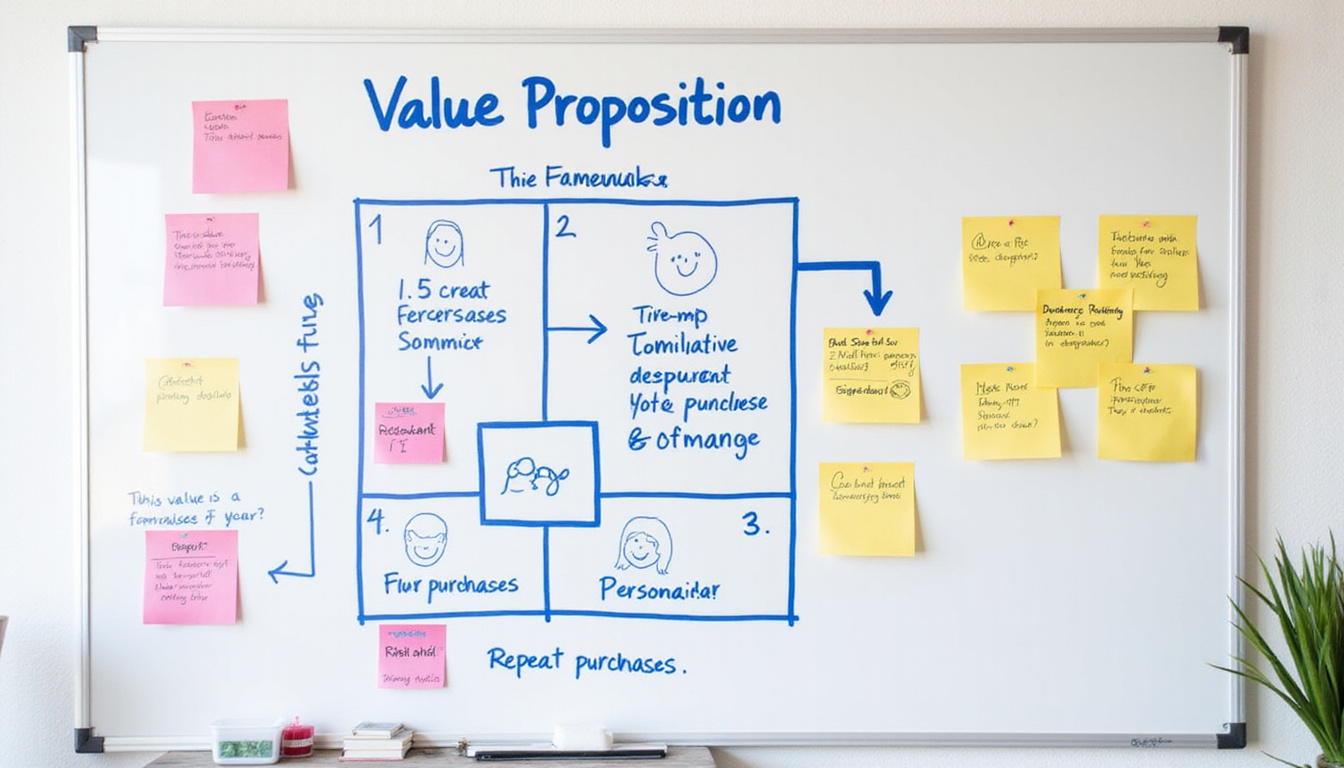
Framework #5: The Four Quadrant Value Proposition
This framework splits the value proposition into four clear parts. It serves as a mini one-page pitch:
- Target Customer
- Problem / Need
- Solution
- Differentiation / Proof
A template might be:
“For [target customer] who [description of problem], [product] is a [category] that [primary benefit]. Unlike [main alternative], it [key differentiator].”
Example for a B2B SaaS Tool
“For financial controllers at mid-sized manufacturing companies who struggle with slow, error-prone monthly closes, CloseWise is a financial close management platform that automates reconciliations and builds audit-ready records. Unlike generic project management tools, it is built for finance teams with GAAP-compliant templates and built-in audit trails.”
This structure makes the value proposition clear for both customers and teams.
You can also tighten it for your website:
“Close your books 3x faster with finance-first workflow automation—purpose-built for controllers at mid-sized manufacturers.”
Framework #6: The “Gain – Pain – Proof” Messaging Stack
This framework breaks your messaging into three parts:
- Gain – What outcome do they get?
- Pain – What problem does it solve?
- Proof – Why should they believe you?
Example for an Online Course Platform
• Gain: “Launch and scale your online course business.”
• Pain: “Avoid wasting months on tech setups and marketing guesswork.”
• Proof: “Trusted by 20,000+ instructors who have generated over $500M in course revenue.”
Combined into a hero section:
Launch and scale your online course business.
Build, market, and sell your course in one place—without tech overwhelm or marketing guesswork. Trusted by 20,000+ instructors who have generated over $500M in course revenue.
Why “Gain – Pain – Proof” Works
• It mirrors the natural decision process—desire, concern, and reassurance.
• It prevents unsupported claims.
• It can adapt easily for ads, emails, and sales scripts.
When designing a landing page, your core value proposition (gain and pain) sits at the top. Proof elements, like testimonials or numbers, follow closely.
Framework #7: The “Before–After–Bridge” (BAB) Formula
The Before–After–Bridge framework uses storytelling:
- Before – Show the current problem.
- After – Describe the better future.
- Bridge – Explain how your product makes the change.
This structure can hold your value proposition.
Example for Project Management Software
• Before: “Projects are scattered across emails, spreadsheets, and chat threads.”
• After: “Everyone knows what to do, when, and where at a glance.”
• Bridge: “TaskFlow brings all your projects, tasks, and communication into one workspace.”
Value proposition hero:
“Turn scattered to-dos into a clear, actionable plan—TaskFlow organizes every project, task, and conversation in one place so your team always knows what’s next.”
BAB works well for sales conversations and long-form pages because it paints a vivid picture of before and after.
Choosing the Right Value Proposition Framework for Your Business
You do not have to use only one framework. Many high-converting pages mix elements from several frameworks.
Here is a simple guide:
• Early-stage startup with unclear positioning:
Use the Value Proposition Canvas and the Four Quadrant framework to build fundamentals.
• Launching or optimizing a landing page:
Use the Conversion-Focused Headline and the Gain–Pain–Proof stack.
• Complex B2B products with long sales cycles:
Combine JTBD for insight with the Four Quadrant and BAB for messaging.
• Consumer products with emotional benefits:
Use JTBD and BAB to reflect the emotional journey.
Build your master value proposition from one framework. Then adapt it for different channels.
Practical Steps to Create Your Own High-Converting Value Proposition
1. Talk to Real Customers (or Prospects)
Even the best framework fails if you rely on guesswork.
• Interview users: Ask, “What were you doing when you started looking for a solution?”
• Ask why they chose you: “What tipped the scale?”
• Ask what they would miss: “If you lost this tool tomorrow, what would you miss most?”
Use their exact words. The best value propositions often use customer language.
2. List Competing Alternatives (Including “Do Nothing”)
Your value proposition must beat:
• Direct competitors
• Workarounds (like spreadsheets, freelancers, or manual processes)
• Doing nothing and enduring the problem
Ask: “Why would someone choose each of these alternatives?” Your differentiation must answer that.
3. Draft Multiple Variations
Do not settle on the first attempt. Write several options:
• 3–5 headlines using the Conversion-Focused formula
• 1–2 Four Quadrant statements
• 1–2 BAB narratives
Then mix and match the best parts.
4. Test on Real People (Not Just Your Team)
• Share your options with 3–5 customers or target audience members.
• Ask them, “What do you think this product does and why would someone use it?”
• If their explanation does not match your intended value, revise the wording.
You can also run A/B tests online to measure signups or leads.
5. Refine Based on Metrics and Feedback
A value proposition is not a one-time exercise. Update it when you change features, shift your market, or when competition changes.
Treat your value proposition as a living asset that evolves with your product and audience.
Common Value Proposition Mistakes (And How to Fix Them)
1. Being Vague or Generic
Weak Example:
“We provide innovative solutions for businesses.”
Strong Example:
“Automate your accounts payable process and cut invoice processing time by 70%.”
Fix: Replace buzzwords with specific benefits and numbers.
2. Talking About Features Instead of Outcomes
Feature Focus:
“We offer AI-powered time tracking.”
Outcome Focus:
“Automatically track your team’s time so you can bill accurately and stop losing revenue.”
Fix: For each feature, ask “So what?” until you reach a clear outcome.
3. Trying to Be Everything
Weak Example:
“Project management for teams of all sizes and every industry.”
Better Example:
“Project management for software teams shipping fast, high-quality releases.”
Fix: Narrow your target audience. Specificity boosts conversion and word-of-mouth.
4. Ignoring Emotional Value
Not every benefit is measurable. Emotions matter:
• Feeling confident
• Reducing anxiety
• Looking competent
• Feeling in control
Combine functional and emotional benefits:
“Automated financial reporting that gives you not only accurate numbers but also the confidence to walk into any meeting prepared.”
5. Lacking Credible Proof
A claim without evidence feels weak.
Weak Example:
“We’re the best email marketing platform.”
Stronger Example:
“Ranked #1 in customer satisfaction among email platforms by 4,000+ marketers.”
Fix: Use numbers, known customers, awards, or case studies to back your claims.
Real-World Examples of Strong Value Propositions
Here are some examples that embody these principles.
Example 1: B2B SaaS – Customer Support Platform
“Deliver 5-star support at scale—without burning out your team.”
HelpDeskPro centralizes tickets from email, chat, and social into one inbox. Its AI-assisted replies cut handle time by up to 40%. Trusted by 3,000+ growing SaaS companies.
Frameworks used include the conversion-focused headline, Gain–Pain–Proof, and a clear target audience.
Example 2: Consumer – Meal Kit Delivery
“Cook chef-designed dinners in 20 minutes—even on your busiest nights.”
Fresh, pre-portioned ingredients and step-by-step recipes come to your door. This lets you skip the grocery store and enjoy meals you are proud to serve.
Frameworks used include JTBD, outcomes with emotional benefit, and a Before–After–Bridge narrative.
Example 3: Professional Services – Accounting Firm for Startups
“Investor-ready financials for venture-backed startups.”
We specialize in SaaS and tech accounting—from revenue recognition to board reporting—so you stay compliant, avoid surprises, and enter fundraising meetings confident in your numbers.
Frameworks used include the Four Quadrant model, JTBD, and emotional benefits (confidence).
Use these examples as a guide, then tailor your own value proposition to your product and customers.
Checklist: Evaluating Your Current Value Proposition
Use this list to audit your homepage or pitch:
- Clarity
Can a stranger explain what you do and who it is for in 10 seconds? - Relevance
Does it speak directly to a known audience and address a clear problem? - Specificity
Are the benefits concrete (e.g., “cut churn by 20%”) instead of vague? - Differentiation
Can a prospect tell why they should choose you over a competitor? - Credibility
Do you show at least one strong piece of proof near your main statement? - Emotional Resonance
Does it tap into how customers want to feel (confident, safe, in control)? - Consistency
Is the same core value repeated in ads, emails, and sales talks?
If you see many gaps, revisit your value proposition using the frameworks in this guide.
One Simple Process to Rewrite Your Value Proposition in a Week
Follow this structured process:
- Day 1–2: Discovery
• Interview 3–5 customers (or prospects).
• Review support tickets, reviews, and sales notes to capture recurring language. - Day 3: Drafting
• Complete a Value Proposition Canvas.
• Write multiple options:
– 3–5 conversion-focused headlines
– 2 Four Quadrant statements
– 1–2 BAB narratives - Day 4: Feedback
• Share options with 3–5 customers or target audience members and internal teams.
• Ask: “What is clearest? What feels most compelling? What sounds like hype?” - Day 5: Testing
• Choose 2–3 top contenders.
• A/B test these options on your homepage or a key landing page, or run short paid tests. - Day 6–7: Decide and Roll Out
• Select the winner based on feedback and early metrics.
• Update your website hero, social bios, decks, sales one-pagers, and onboarding flows.
This process gives you a sharper, tested value proposition that supports your whole go-to-market strategy.
FAQ About Value Propositions
1. What is a good value proposition example?
A good value proposition is clear, specific, and customer-focused. For example:
“Send personalized emails at scale—without writing a single line of code.”
This statement shows who it is for, what outcome it creates, and a key differentiator.
2. How do you write a strong value proposition statement?
To write a strong statement:
• Define your ideal customer clearly.
• Identify their main problem and desired outcome.
• Describe how your product creates that outcome.
• Highlight what makes you different or better.
• Add proof such as metrics or testimonials.
Then, compress this into one or two clear sentences.
3. How is a unique value proposition different from a slogan?
A unique value proposition explains the concrete value you deliver and why you are the better choice. A slogan is brief and emotional. For example, “Think Different” is a slogan. Apple’s real value lies in its beautifully designed, user-friendly devices that work seamlessly together.
Turn Your Value Proposition Into a Competitive Advantage
Many companies treat the value proposition as a checkbox. They write one generic sentence for a pitch deck, put it on the homepage, and move on.
You can do better by:
• Grounding your value proposition in real customer tasks, pain points, and desired gains.
• Using frameworks such as the Value Proposition Canvas, JTBD, Gain–Pain–Proof, and Before–After–Bridge.
• Testing and refining your message with real users and data.
Start by sharpening your value proposition. Update your homepage or pitch today. Use the frameworks in this guide to draft sharper alternatives. Share them with customers, run simple A/B tests, and track your conversions. When your value is clear, every marketing dollar and sales conversation works harder for you.