Growth Loops: The Ultimate Playbook for Viral User Acquisition

Below is the rewritten text. The sentences have been simplified so that words are closer together in their dependencies. The structure and headings remain intact, and the copy now targets a Flesch reading score between 60 and 70. ------------------------------------------------------------
Growth loops are powerful systems in modern growth strategy. They remain misunderstood even though they drive self-sustaining, compounding user growth. Many teams still focus on funnels and one-off “viral campaigns.” Fast-growing products use growth loops to build momentum and bring in new users over and over.
In this playbook you will learn what growth loops are, why they work better than funnels, how to design and measure them, and how to use them in your product. Whether you build a SaaS tool, a marketplace, a consumer app, or a B2B platform, you will find ideas here that help you add recurring value.
1. What Are Growth Loops?
At its core, a growth loop is a closed system. One cycle’s output becomes the next cycle’s input. Rather than follow a long path in a funnel, growth loops recirculate value. They pull in more users, activity, or revenue again and again.
One way to see it is:
Funnel: Input → Process → Output → Done
Growth loop: Input → Process → Output → Feeds back into Input → Repeats
In user acquisition, each new user or action starts another cycle that brings more people. When designed well, loops build compounding growth. The more cycles, the stronger the loop becomes.
The Three Core Elements of a Growth Loop
Every strong loop has three parts:
- Input
The start of the loop. This may be a new user, an invite sent, a piece of content created, or money spent on ads. - Action(s)
The step that turns input into something valuable. This could be a sign-up, sharing, content creation, or inviting collaborators. - Output that Reinforces Growth
The result that brings in more inputs. This could be new users, more content, better rankings, or revenue that funds further growth.
When these parts fit together and support your product’s value, you have a working growth loop.
2. Growth Loops vs Traditional Growth Funnels
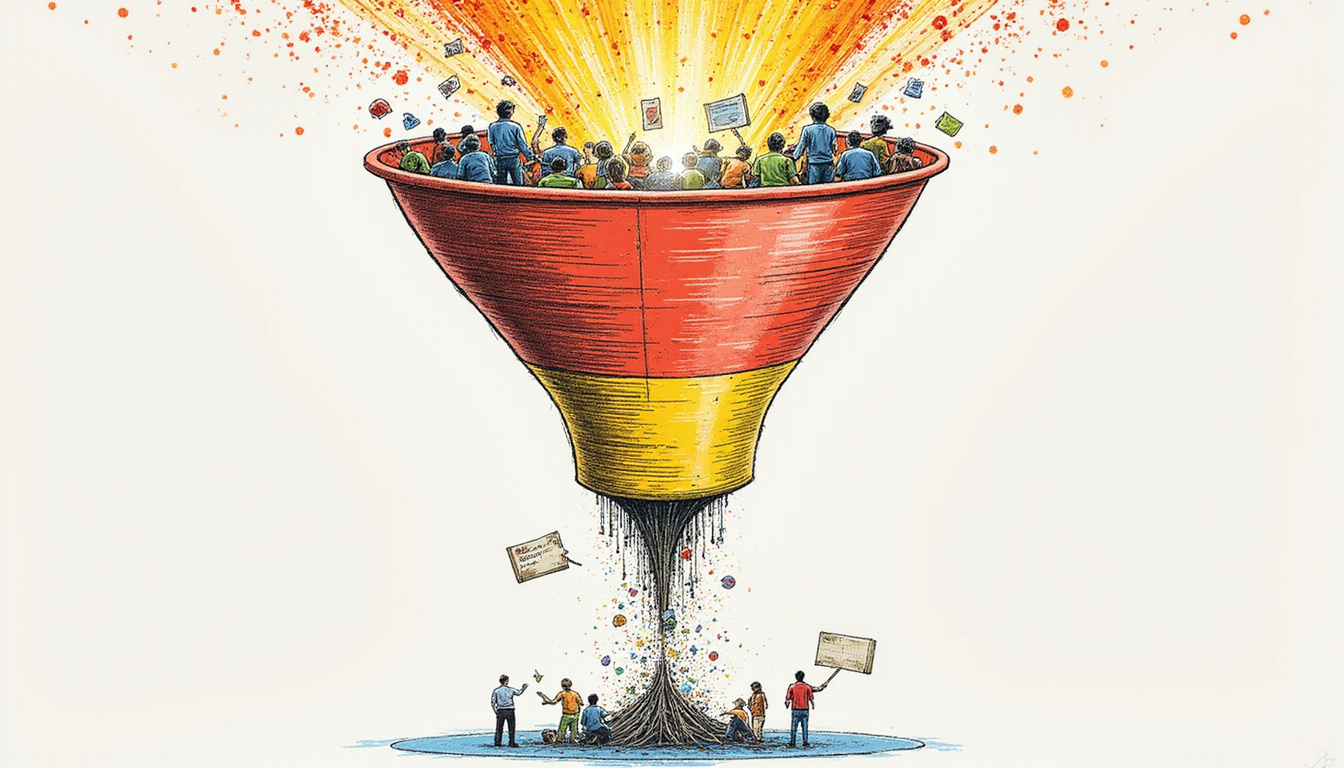
Many teams still use the AARRR funnel: Acquisition → Activation → Retention → Referral → Revenue. Funnels help diagnose where users drop off, but they do not show how growth builds on itself.
Why Funnels Fall Short
• Funnels move in one direction only.
• Funnels end at conversion or retention.
• Funnels do not naturally include feedback into the system.
• Funnels focus on one campaign rather than a full system.
This means growth is often expensive and fragile. It depends on factors like ad costs or algorithm changes.
Why Growth Loops Are Superior for Sustainable Growth
Growth loops instead focus on systems that reinforce themselves. They naturally build network effects and let users draw in more users. Loops let teams focus on actions that build compounding growth. They help you see how today’s work builds tomorrow’s results.
This is why companies like Dropbox, LinkedIn, Airbnb, TikTok, and Zoom use growth loops instead of simple funnels or one-off campaigns.
3. Types of Growth Loops (With Real-World Examples)
There is no single universal loop. Products may use one or a combination of loops. Below are some common types with real examples.
3.1 Viral & Referral Growth Loops
These loops are familiar. Each user can bring in more users.
Pattern
- A user gets value from the product.
- The user feels motivated to share, invite, or refer.
- The invitee joins and finds value.
- The new user can then invite others.
Examples
• Dropbox: Its referral program gives extra storage to both the sender and the friend. Each new user has the chance to send more invites.
• Zoom: Users share meeting links. Guests join and then sign up to host future meetings.
Key Levers
• Easy invites with one click and prefilled messages.
• Clear benefits for both sender and receiver.
• In-product prompts at moments when users feel success.
3.2 Content & SEO Growth Loops
In these loops, users or the company create content that brings in more visitors through search or social channels.
Pattern
- A user or team makes useful content (posts, profiles, listings, docs).
- The content is shared or indexed by search engines.
- New users discover the content.
- Some of these visitors join and create their own content.
Examples
• YouTube: Creators upload videos that rank well and get recommended. Viewers become new creators who add more content.
• Notion: Users publish templates that get indexed by Google. Visitors see them, sign up, and then copy or modify the doc.
• Airbnb: Hosts post property listings that rank for local searches. Travelers look up places and book, and some become new hosts.
A well-built SEO loop is a lasting asset. Each new piece of content draws in users over time.
3.3 Product-Led Sales & Collaboration Loops
B2B and productivity tools often build loops through collaboration.
Pattern
- A user joins to solve a need.
- They invite teammates or clients to work together.
- Invited users join and engage with the work.
- Some collaborators then start their own teams and loop again.
Examples
• Slack: A team starts using Slack. They invite partners and other departments. This work spreads across organizations.
• Figma: Designers share live files with colleagues. The colleagues get accounts to comment and edit. Some then launch their own projects.
This loop is strong for enterprise products because it spreads as part of real work.
3.4 Marketplace & Network-Effect Loops
In marketplaces, more supply attracts more demand. In turn, more demand brings in more supply.
Pattern
- New sellers, hosts, or drivers join.
- More inventory raises quality and choices.
- More buyers, guests, or riders arrive.
- Better earnings attract even more supply.
Examples
• Uber: More drivers mean shorter wait times. This attracts more riders who then encourage more drivers to join.
• Airbnb: More hosts create more listings. Travelers see many options and book. This growth brings in more hosts.
These loops depend on network effects. The product improves as more people join.
3.5 Paid Acquisition Loops (Capital as a Flywheel)
Not all loops are viral. Some loops use revenue to fuel more ads.
Pattern
- The company spends money on ads.
- Ads attract new users and revenue.
- Some revenue is reinvested in more ads.
- This cycle grows as ad budgets increase.
Examples
• DTC Ecommerce Brands: Ads bring first purchases. Loyal customers buy again. Profits help fuel further ad spending.
• Subscription Apps: Paid installs turn into subscribers. Recurring revenue pays for more ads steadily.
This loop links revenue and user acquisition as a self-reinforcing engine.
4. The Mechanics of a High-Performance Growth Loop
Designing a loop is about building a system, not just a quick fix. Many variables decide if a loop drives growth in a meaningful way.
4.1 The Loop Equation: How to Model Growth
Think of the equation simply:
New Users Next Period = (New Users This Period × Loop Factor) + External Inputs
• The Loop Factor shows how many new opportunities each user brings.
• External Inputs include paid ads, PR, and partnerships.
When the Loop Factor is around 1 or higher, growth compounds. Even a low Loop Factor can reduce the need for external inputs.
4.2 Key Metrics for Growth Loops
Most loops use a few main measurements:
• Activation Rate
The percentage of sign-ups that reach an early value moment.
• Loop Participation Rate
The percentage of activated users who take part in the loop (invite, share, create content, etc.).
• Loop Strength (or K-Factor)
The average number of new users each participant brings in.
• Time to Loop Completion
How long it takes to finish one cycle. Faster loops mean faster growth.
• Retention and Cohort Quality
Whether loop-acquired users show high engagement and long-term value.
4.3 Friction and Incentives
Every loop lives on the balance between friction and motivation.
• Lower friction: Make the action (invite, share, publish) very easy.
• Align incentives: Provide rewards that matter to users.
• Build into the workflow: Let the loop feel like a natural part of the product rather than an extra step.
5. How to Design Your Own Growth Loops (Step-by-Step)
You do not simply copy a loop. You must design one that fits your product’s value. Here is a clear process.
Step 1: Map Your Core Value
Answer these questions:
• What is the main value your product gives?
• What is the “aha moment” that shows this value?
• What key actions lead users to this moment?
Loops must be built on real value. Without it, users will not share, invite, or create content.
Step 2: Identify Natural Sharing or Expansion Moments
Look for moments when:
• Users must work with others.
• Output is naturally shareable or public (like documents or reports).
• Success creates social proof (for example, leaderboards or testimonials).
• There is already a reason for a user to bring someone new.
These moments are the best for embedding a growth loop.
Step 3: Choose the Right Type of Growth Loop
Decide by asking:
• Is the product social or collaborative? → Try referral or collaboration loops.
• Does it create content or assets? → Use content or SEO loops.
• Is it a marketplace? → Focus on network-effect loops.
• Can you gain users profitably with ads? → Add paid acquisition loops.
You may combine loops later, but start with one that fits your core use.
Step 4: Design the Loop Mechanics
For your chosen loop, map out these details:
- Trigger – What moment starts the loop?
- Action – What exactly do you want the user to do (invite, share, create)?
- Channel – How is the action executed (email, link, in-product share, etc.)?
- Recipient Experience – What sees the new user first?
- Conversion Path – How does the user quickly see value?
- Re-entry into Loop – When can they perform the loop action again?
Make this map clear. A flow chart or diagram can help.
Step 5: Build for the Recipient, Not Just the Sender
Many loops fail because they only focus on the existing user. Ask:
• If you send an invite, does the recipient see a simple and clear sign-up experience?
• If someone views public content, does the landing page explain the value clearly?
• Can a new user get value before having to commit too much (for example, with guided templates or demo data)?
A good first impression for the new user is key to a strong loop.
Step 6: Instrument, Test, and Iterate
For every loop, do the following:
• Track how often the action is attempted.
• Measure the conversion from attempt to completed loop.
• Count how many new users are brought in by each cycle.
• Measure engagement and retention among loop-acquired users.
Test different placements, wording, incentive levels, and landing flows. Expect to iterate until the loop signals success.
6. Concrete Examples of Growth Loops You Can Implement
Below are actionable patterns and ideas to adapt.
6.1 SaaS Collaboration Loop
Use Case: Project management, design tools, CRMs, analytics platforms.
Loop Structure
- A user signs up and creates a project, workspace, or file.
- To gain full value, they invite teammates or clients.
- Invited users sign up and collaborate.
- Some collaborators start their own workspaces.
Implementation Ideas
• Make collaboration obvious. For example, include an “Add stakeholders” step when a project is created.
• Use guest access that nudges users to sign up fully.
• Offer benefits when teams hit a milestone (like extra features unlocked when 3+ users join).
• Provide templates designed for teamwork (for instance, “Client Onboarding Workspace”).
6.2 User-Generated Content SEO Loop
Use Case: Marketplaces, community platforms, portfolio tools, course platforms.
Loop Structure
- Users create public pages (profiles, portfolios, case studies).
- These pages are optimized for search engines.
- New visitors find them via search or social media.
- Some visitors sign up to create their own pages.
Implementation Ideas
• Give users SEO-friendly templates with ready meta tags and headings.
• Let users easily share their pages on social networks like LinkedIn and Twitter.
• Add a clear call to action on every page like “Create your own portfolio in 2 minutes.”
• Ensure automated sitemaps and strong SEO practices.
6.3 Referral Rewards Loop
Use Case: Consumer apps, fintech, productivity tools, subscription services.
Loop Structure
- A user reaches an important milestone.
- The app shows a clear referral incentive (money, credits, or features).
- The user shares an invite link with friends.
- The friend joins and gets a reward, and this user also benefits.
- New users reach milestones and are prompted to refer others again.
Implementation Ideas
• Tie rewards closely to the product’s benefits (like extra credits or upgraded features).
• Show social proof such as “You and 3 friends save together.”
• Use time-limited offers to create urgency.
7. Common Mistakes When Building Growth Loops
Even teams that know about growth loops can make mistakes. Avoid these to save time.
Mistake 1: Treating Growth Loops as a “Feature,” Not a System
A growth loop is not just a button like “Invite a Friend.” It is an entire system that connects product design, UX, messaging, analytics, and incentives. If one part fails, the loop breaks.
Mistake 2: Misaligned Incentives
If your incentives only bring low-quality users, encourage spam, or reward sharing without real use, your loop will only look good on paper. Focus instead on engaged and long-lasting users.
Mistake 3: Building Loops Too Early
Do not force a growth loop before your product shows clear value. Without proven value, users will not be motivated to share or create new content.
First, make sure you have:
• Proven product-market fit (with strong retention and engagement).
• A clear core journey that shows value.
• Good activation metrics.
Then, improve growth through loops.
Mistake 4: Ignoring Quality of Loop-Acquired Users
Not every loop brings equally valuable users. For example, a giveaway may get low-interest sign-ups. Ensure you track retention, conversion to key events, and overall user quality.
Mistake 5: Over-Reliance on a Single Loop
Even strong loops can weaken over time due to market changes and saturation. Mature companies mix multiple loops such as SEO, referrals, collaborations, and paid campaigns. Aim for a portfolio of loops.
8. Measuring and Optimizing Growth Loops
To run growth loops well, use a rigorous measurement mindset.
8.1 Instrument the Full Loop
Tie your analytics events to each stage of the loop:
• Trigger: When a user completes an action.
• Prompt: When a referral or share prompt appears.
• Action: When an invite is sent or content is published.
• Recipient Event: When an invite is opened or the public page is visited.
• Conversion: When a new sign-up results from the loop.
• Re-loop: When this new user starts the loop process.
Map the drop-offs closely for leverage.
8.2 Track K-Factor and Loop Efficiency
Use metrics like the K-factor (average invites times conversion rate) to judge loop strength. Combine data from different loops to see the overall impact on growth.
8.3 Shorten Time-to-Value Within the Loop
Shorten the time before a user sees value. For example:
• Remove friction (no-credit-card trials, demo data, guided sign-ups).
• Tailor onboarding to the user’s context (e.g., “You were invited to collaborate—start here”).
• Use guided flows to get users to an early “aha moment.”
Faster loops bring more cycles and faster growth.
9. Growth Loops by Product Stage
The right loop depends on your product’s stage.
Early Stage (Pre–Product-Market Fit)
Focus on understanding the core value, activation, and retention. Experiment with low-friction loops such as basic invites or founder-led introductions.
Growth Stage (Proven Value, Need for Scale)
Focus on the highest-leverage loops. Layer multiple loops such as full referral programs, robust SEO loops, collaboration loops, and paid acquisition loops.
Mature Stage (Optimization and Defensibility)
Focus on efficiency, profitability, and defensive growth. Optimize your loops further or add new ones such as ecosystem integrations, partner-led loops, or community events.
10. Realistic Benchmarks and Expectations
It is easy to think of viral loops as “set-it-and-forget-it” engines. In reality, products rarely get a single loop with a K-factor above 1 all the time. Instead, they combine loops that bring moderate organic growth with strong retention and monetization. Complement these with paid and outbound efforts. Even if loops contribute 20–40% of new user acquisition, they can lower costs greatly and improve unit economics.
11. FAQ: Common Questions About Growth Loops
Q1. How are growth loops different from viral loops?
Viral loops are a type of growth loop where users directly invite others, usually with incentives. Growth loops include viral loops as well as SEO loops, content loops, marketplace loops, and paid loops. Any closed system where outputs drive new inputs is a growth loop.
Q2. Can growth loops work for B2B products with long sales cycles?
Yes. B2B products benefit from product-led and collaboration loops. For instance, free access for collaborators or partners can expand usage across teams. Additional loops can build around case studies, webinars, and partner ecosystems.
Q3. How do I know if my growth loop is working?
A loop works if every cycle brings in extra users, activity, or revenue. Check that loop-acquired users engage well and that the proportion of new users from loops grows over time. A clear path from action to re-entry is a sign of a healthy loop.
12. Turn Theory Into Compounding Growth
Designing and executing strong growth loops is a high-leverage task for your product. Instead of chasing short-term hacks or one-time campaigns, focus on building systems that grow stronger with each cycle.
You have seen that:
• Growth loops turn one-time actions into ongoing acquisition engines.
• Different loops—viral, content, collaboration, marketplace, and paid—match different product models.
• Metrics, incentives, and user experience are key to loop strength.
• Sustainable growth comes by layering multiple loops over time, all built on real value.
If you are serious about predictable and profitable growth, now is the time to act. Map your current user journey, find moments where users share or collaborate naturally, and build at least one clear growth loop around that moment. Then track it, test variations, and iterate.
Do not leave your growth to chance or one-off campaigns. Turn your product into a compounding engine powered by strong growth loops. Let every new user spark the next wave of acquisition.